
As you navigate the world of betting, you will inevitably encounter variance, a concept that can significantly impact your outcomes. You may have experienced streaks of wins or losses, leaving you wondering about the role of luck and skill in your betting endeavors. Your understanding of variance will help you make informed decisions and separate chance from ability, allowing you to refine your strategy and improve your overall betting performance.
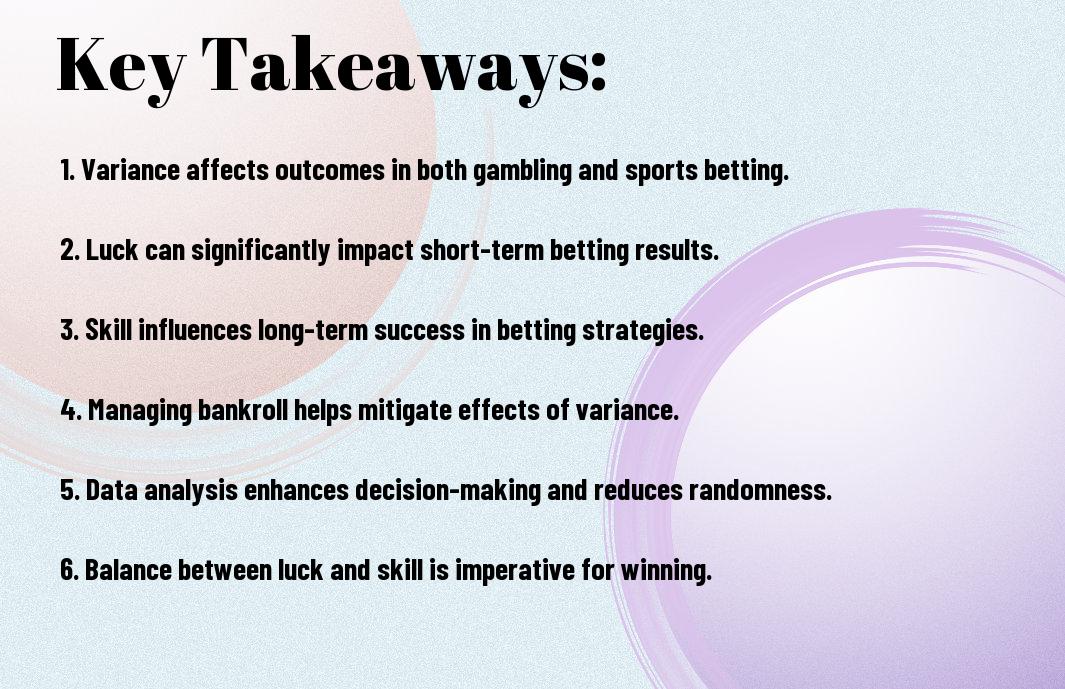
Key Takeaways:
- Variance plays a significant role in betting, where luck can greatly influence short-term results, making it crucial to differentiate between luck and skill in evaluating performance.
- Skill in betting involves making informed decisions based on data and analysis, while luck refers to the unpredictable outcomes that can affect the results of these decisions.
- Understanding variance helps bettors manage their expectations and emotions, as they can experience winning or losing streaks that do not necessarily reflect their actual skill level.
- A large sample size is necessary to accurately assess a bettor’s skill, as short-term variance can mask true ability, leading to incorrect conclusions about betting strategies.
- Effective bettors adapt to variance by maintaining a long-term perspective, adjusting strategies based on data, and avoiding impulsive decisions driven by recent outcomes rather than overall performance.
Fundamentals of Variance
A key concept in betting, variance refers to the degree of difference between your expected and actual outcomes. As you navigate the world of betting, understanding variance is vital to making informed decisions and managing your expectations.
Defining Statistical Variance
Varied results are a natural part of betting, and statistical variance helps you quantify this phenomenon. You can think of it as a measure of how spread out your outcomes are from the average, allowing you to better understand the uncertainty involved in betting.
Short-term vs Long-term Variance
By examining your betting history, you can identify patterns of variance that emerge over different time frames. You will notice that short-term variance can be quite volatile, while long-term variance tends to even out, giving you a more accurate picture of your betting performance.
Defining the distinction between short-term and long-term variance is vital, as it helps you avoid making emotional decisions based on a few unusual outcomes. You will be able to recognize that a streak of bad luck is just that – luck – and not a reflection of your overall betting strategy, allowing you to stay focused on your long-term goals.
Probability and Betting
Any bet you place involves probability, which is a measure of the likelihood of an event occurring. Understanding probability is crucial to making informed betting decisions, as it helps you assess the potential risks and rewards of your bets.
Random Distribution
By analyzing past data, you can identify patterns and trends that may influence the outcome of an event, allowing you to make more accurate predictions and informed betting decisions, considering the random distribution of outcomes.
Expected Value Calculations
Random events can be analyzed using expected value calculations, which help you determine the potential return on investment for a particular bet, taking into account the probability of winning and the potential payout, enabling you to make more strategic decisions.
Also, as you investigate deeper into expected value calculations, you will find that they can be applied to various aspects of betting, from assessing the likelihood of a team winning to determining the potential return on investment for a particular wager, allowing you to refine your betting strategy and make more informed decisions based on your analysis of the data and probabilities involved.

Skill Elements in Betting
Now that you understand the role of luck in betting, it’s time to focus on the skill elements that can help you make informed decisions. You will learn how to develop a strategy, manage your bankroll, and make smart bets.
Strategy Development
On the path to becoming a skilled bettor, you need to develop a solid strategy that works for you. You will need to analyze data, assess risks, and set goals to create a tailored approach to betting.
Bankroll Management
Beneath the surface of successful betting lies effective bankroll management. You must learn to allocate your funds wisely, setting limits and making smart decisions to minimize losses and maximize gains.
To manage your bankroll effectively, you should start by setting a budget and sticking to it. You will need to determine how much you can afford to lose and make sure you don’t bet more than that. By doing so, you will be able to enjoy betting while minimizing the risk of financial difficulties, and you will be able to bet with confidence, knowing that you have a solid financial foundation to fall back on.
Luck Factor Analysis
Unlike other factors, luck plays a significant role in betting variance. You can learn more about the impact of luck on your game by reading Luck Vs. Skill: How To Look At The Variance In Your Game to understand the dynamics at play.
Random Outcomes
Luckily, you can analyze random outcomes to identify patterns in your betting history, helping you make informed decisions about your strategy.
Streaks and Patterns
Luckily, recognizing streaks and patterns in your betting outcomes can help you adjust your approach to minimize losses and maximize gains.
And as you research deeper into streaks and patterns, you’ll discover that they can be influenced by various factors, including the type of game, your skill level, and the level of competition, allowing you to refine your strategy and make more accurate predictions about your chances of winning.
Risk Assessment
Keep in mind that risk assessment is a vital step in understanding variance in betting, as it helps you evaluate the potential outcomes of your bets and make informed decisions about your wagers.
Variance Calculation Methods
Around the concept of variance, calculating methods are available to help you quantify the potential risks and rewards of your bets, allowing you to make more accurate predictions and adjustments to your strategy.
Risk Tolerance Levels
For your betting strategy to be effective, you need to determine your risk tolerance levels, which will help you decide how much you are willing to risk on each bet and how to manage your bankroll accordingly.
It is crucial to consider your risk tolerance levels when developing your betting strategy, as they will impact your overall approach to betting and help you avoid making impulsive decisions that can negatively affect your bankroll, you should assess your financial situation, betting goals, and personal preferences to determine the level of risk you are willing to take, and adjust your strategy accordingly to ensure that you are betting within your means and minimizing potential losses.
Practical Applications
Not understanding variance can lead to poor decision-making in betting, but by recognizing its impact, you can make informed choices to manage risk and maximize returns.
Betting Size Adjustments
Scaling your bets according to your bankroll and confidence level is imperative, as you will need to adjust your wagering size to avoid significant losses during downswings and capitalize on upswings.
Performance Tracking
Adjusting your strategy based on your performance over time allows you to identify areas for improvement and make data-driven decisions to optimize your betting approach, helping you to better navigate the impact of variance on your results.
Performance monitoring enables you to evaluate your betting decisions, identifying whether your wins and losses are due to skill or luck, and make necessary adjustments to your strategy, allowing you to refine your approach and make more informed bets, ultimately helping you to achieve your betting goals.
To wrap up
Considering all points, you now have a better understanding of variance in betting, and how luck and skill intersect. You see that your outcomes are influenced by both factors, and you can make informed decisions by acknowledging the role of chance and your own abilities. By grasping this concept, you can refine your strategy and manage your expectations, ultimately enhancing your betting experience and potential for success. Your approach will become more effective as you apply this knowledge to your betting endeavors.
FAQ
Q: What is variance in betting and how does it impact my wagering experience?
A: Variance in betting refers to the fluctuations in results that occur due to chance, separate from the skill level of the bettor. It’s vital to understand that variance can lead to both winning and losing streaks, even for skilled bettors. Over time, the law of large numbers dictates that results will tend towards the expected value, but in the short term, variance can significantly influence outcomes. Managing bankrolls and setting realistic expectations are key strategies for navigating variance in betting.
Q: How do luck and skill interplay in determining betting outcomes, and can I rely solely on skill to win?
A: While skill plays a significant role in making informed betting decisions, luck is also a significant factor, especially in the short term. Skilled bettors can make better decisions based on analysis and experience, but luck can still cause unexpected outcomes. It’s a combination of both skill and luck that determines the success of a bet. Relying solely on skill is not enough; understanding and adapting to the role of luck in betting is vital for long-term success. Experienced bettors often adjust their strategies to account for variance, ensuring that they can weather losing streaks and capitalize on winning ones.
Q: What strategies can I use to mitigate the effects of variance and improve my chances of long-term success in betting?
A: To mitigate the effects of variance, bettors can employ several strategies. First, maintaining a disciplined bankroll management system is vital, ensuring that no single bet is so large that it significantly depletes your bankroll in case of a loss. Second, diversifying your bets can help spread risk. Additionally, setting realistic expectations and understanding that variance is a natural part of betting can help manage emotional responses to winning and losing streaks. Finally, continuously learning and improving your betting skills, including analyzing past bets and adapting to new information, can enhance your decision-making process and improve your long-term prospects. By combining these strategies, bettors can navigate the challenges posed by variance and work towards achieving their betting goals.


